How the score works
The live card above shows an aurora viewing outlook for Kiruna, Swedish Lapland (67.8558° N, 20.2253° E), combining the real-time planetary KP index from NOAA Space Weather Prediction Center with cloud cover and temperature from Open-Meteo. It updates every 10 minutes.
The score itself: the number in the live card is an Aurora Dreams planning score, not a calibrated probability, an official NOAA product, or a guarantee. It combines two live inputs: the KP index sets a base value (KP 1 ≈ 40, KP 2 ≈ 60, KP 3 ≈ 75, KP 4 ≈ 85, KP 5+ ≈ 95–98 at Kiruna's latitude), and current cloud cover then subtracts up to 80 points — because even a strong aurora is invisible through overcast sky. Clear sky matters more than a high KP. NOAA provides the KP index only; the score itself is ours.
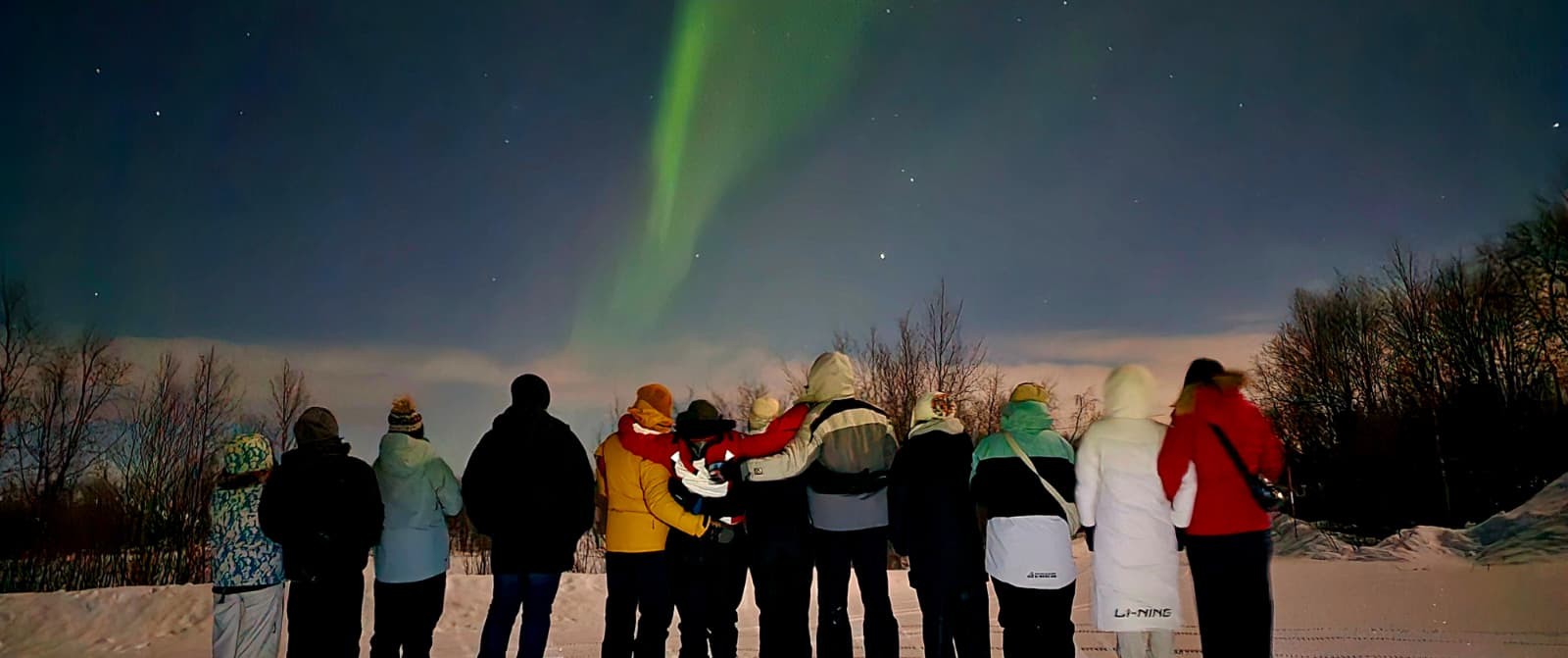
Aurora viewing at 67° N (Kiruna's latitude): aurora borealis becomes visible from KP index 1–2. KP 3–4 produces active, bright displays. KP 5 and above is classified as a geomagnetic storm and typically results in spectacular aurora visible across the whole sky.
| KP | Activity | What it usually means in Kiruna |
|---|---|---|
| 0 | Very quiet | Aurora is usually too faint to pick out, even under a clear sky. |
| 1–2 | Quiet | Aurora is commonly visible here under a clear, dark sky — often a green arc low on the northern horizon. This is a normal working night for a guided hunt. |
| 3–4 | Active | Brighter, more mobile displays that can reach higher up the sky. Movement and structure become easier to see with the naked eye. |
| 5–6 | Geomagnetic storm | Strong displays across a large part of the sky, sometimes with visible reds and purples in photographs. |
| 7–9 | Severe storm | Rare. Aurora can fill the sky and be visible far further south than Kiruna. |
Cloud cover overrides all of this: a KP 5 storm is invisible through an overcast sky, while KP 1 under clear sky is often a good night. Sightings are never guaranteed.
Best viewing time: aurora is most active around magnetic midnight, approximately 22:00–02:00 local time in Kiruna. Clear skies (cloud cover below 30%) are generally ideal because the aurora forms roughly 100–400 km above the Earth's surface (NOAA: Aurora) — cloud blocks visibility.
Season: The Northern Lights may be visible from late August into early April when the sky is dark enough, while the main season is generally September through March. Peak months are December, January, and February because of longer dark hours and strong winter solar activity. In summer (roughly May–July) the midnight sun keeps the sky too bright for aurora viewing regardless of KP.
Honest expectations: no forecast can guarantee the northern lights tonight — aurora depends on solar activity that changes hour by hour. The good news for Kiruna: at 67°N even quiet geomagnetic conditions (KP 1–2) regularly produce visible aurora under a clear sky, which is why locals care more about the cloud map than the KP number. When clouds are moving, where you stand matters — a guided chase can drive 50–100 km to reach a gap in the cloud cover that never opens over the city.
Planning ahead instead of tonight? Use our aurora trip date calculator, read the guide to reading Kiruna aurora forecasts, or see the best time of year for northern lights in Kiruna. Ready for tonight? Book a guided aurora hunt or ask us on WhatsApp what tonight looks like.