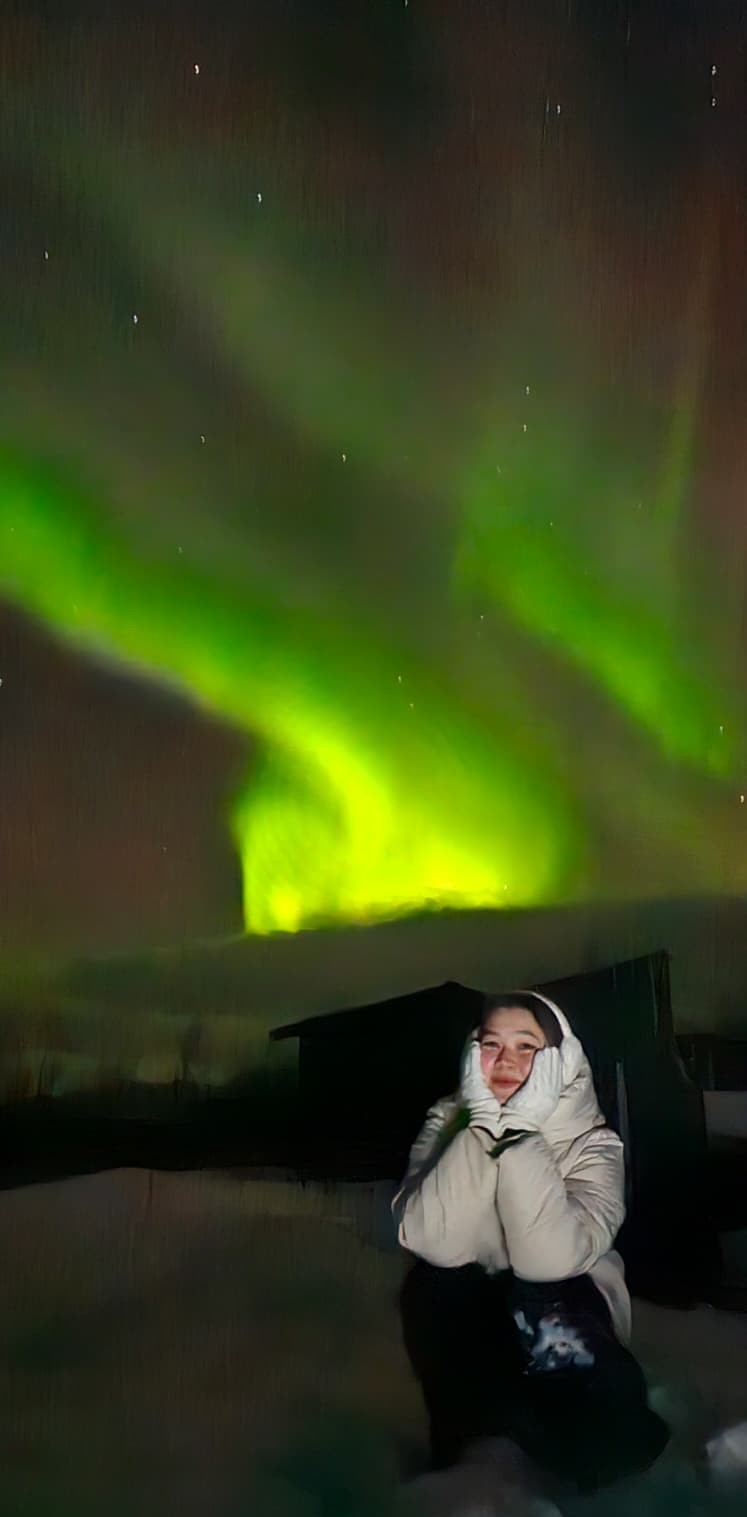
A KP index of 3 means one thing in Stockholm and something completely different in Kiruna. This guide translates the global forecast numbers into specific recommendations for 67.8° N.
What the KP index actually measures
KP is a global number — a planetary measurement of geomagnetic activity scaled 0-9, updated every 3 hours by NOAA. It comes from 13 stations around the world sampling the Earth's magnetic field deviation.
The important bit: a higher KP means the auroral oval pushes further from the magnetic pole toward the equator. At KP 1 the oval covers Alaska, northern Scandinavia, and the far north of Canada/Russia — you see aurora at 67° N. At KP 5 the oval reaches Scotland, Stockholm, northern USA. At KP 8 you can see aurora in Texas.
KP to "what you'll see in Kiruna"
| KP | In Kiruna tonight |
|---|---|
| 0 | Very faint green glow on northern horizon. Visible only in a properly dark sky (no moon, no clouds, 20+ km from streetlights). Beginners miss it. |
| 1 | Visible arc on the northern horizon. If it's clear and dark you'll see it without help. |
| 2 | Clear arc overhead sweeping north-to-south. Good for photography. This is the typical "I saw the aurora" night at Kiruna's latitude. |
| 3 | Active arcs with dancing motion. Brighter greens, possibly hints of purple at the bottom. First-time viewers are usually speechless. |
| 4 | Full overhead display. Rapid movement. Colour saturation clearly visible — no camera needed to see it. |
| 5 | Geomagnetic storm. Aurora covers most of the sky including the south. Reds and purples common. You'll remember this forever. |
| 6-7 | Major storm. Spectacular. Aurora visible as far south as southern England. In Kiruna, conditions permitting, this is once-a-decade viewing. |
| 8-9 | Extreme storm. Very rare. Texas sees aurora. If you're in Kiruna during one of these you're genuinely lucky. |
Cloud cover beats KP
The aurora forms roughly 100-400 km above Earth (NOAA). Cloud sits at 1-10 km. Any cloud blocks your view. A cloudy night with KP 7 shows nothing. A clear night with KP 1 shows aurora.
Practical rule: cloud cover below 30% = go. 30-60% = go but drive to clearer spot. Above 70% = save the battery and try tomorrow.
Use the live Kiruna aurora conditions page for both values side by side. We publish a single conditions score that factors KP and cloud together — a planning score, not a calibrated probability.
Timing within the night
Aurora follows a daily pattern called the auroral substorm. Activity typically peaks around magnetic midnight, which for Kiruna is 22:00-02:00 local time in winter.
Activity often comes in waves — you might get 30 minutes of strong aurora, 45 minutes of nothing, then another burst. Don't give up after one hour. This is why guided tours run 3-4 hours and not 1 hour.
Book a 3-4 hour guided aurora tour → Our guide monitors live KP + cloud feeds in real time and moves the group to the best spot. From 1490 SEK.Reading the NOAA 3-day forecast
Go to services.swpc.noaa.gov/products/noaa-planetary-k-index-forecast.json or our simplified forecast page. You'll see KP predictions for the next 72 hours in 3-hour blocks.
How to use it:
- Find the 21:00-03:00 UTC blocks — these are your Kiruna evening hours.
- Note the predicted KP. If KP 2 or higher and cloud forecast is clear, book for that night.
- KP forecasts 1 day out are ~75% accurate. 3 days out, closer to 40%. Re-check the morning of your tour.
Solar wind — the deeper forecast
For real aurora chasers: KP is a trailing indicator. The leading indicator is the solar wind stream measured by NASA's ACE and DSCOVR satellites at the L1 Lagrange point (~1.5M km sunward of Earth).
Key parameters:
- Bz (southward component of the interplanetary magnetic field): when Bz is strongly negative (below −10 nT), aurora is likely.
- Solar wind speed: above 500 km/s increases odds.
- Density: above 10 particles/cm³ amplifies displays.
These readings give you ~30-60 minutes heads-up before KP spikes. Advanced viewers watch these on spaceweather.live or similar. Our guides watch them on tour.
Moon — the underrated factor
A full moon washes out faint aurora the same way city streetlights do. Plan your trip around a new moon or crescent moon week if you're optimising for weak aurora nights. During strong displays (KP 4+) the moon makes no difference.
Full moon dates in Kiruna aurora seasons 2026-2027: 3 Oct 2026, 1 Nov 2026, 1 Dec 2026, 30 Dec 2026, 29 Jan 2027, 27 Feb 2027, 29 Mar 2027. Avoid 4 days either side of these.
Put it together
Before each Kiruna night:
- Check tonight's live forecast for KP + cloud cover summary.
- If both green, go out 21:30 and stay until 01:30.
- Arrive at a spot > 20 km from streetlights. Give eyes 15 minutes to adapt.
- Face north initially, then look up at around 22:30 (magnetic midnight).
- Don't give up after one hour. Wait for the substorm cycle.
Or skip the planning and book a guided tour — we do all this interpretation for you, in real time, with a heated vehicle for when you need a break.
Related reading
- Live Kiruna aurora forecast (updates every 10 minutes)
- Best month to visit Kiruna
- Month-by-month breakdown
- Aurora photography settings