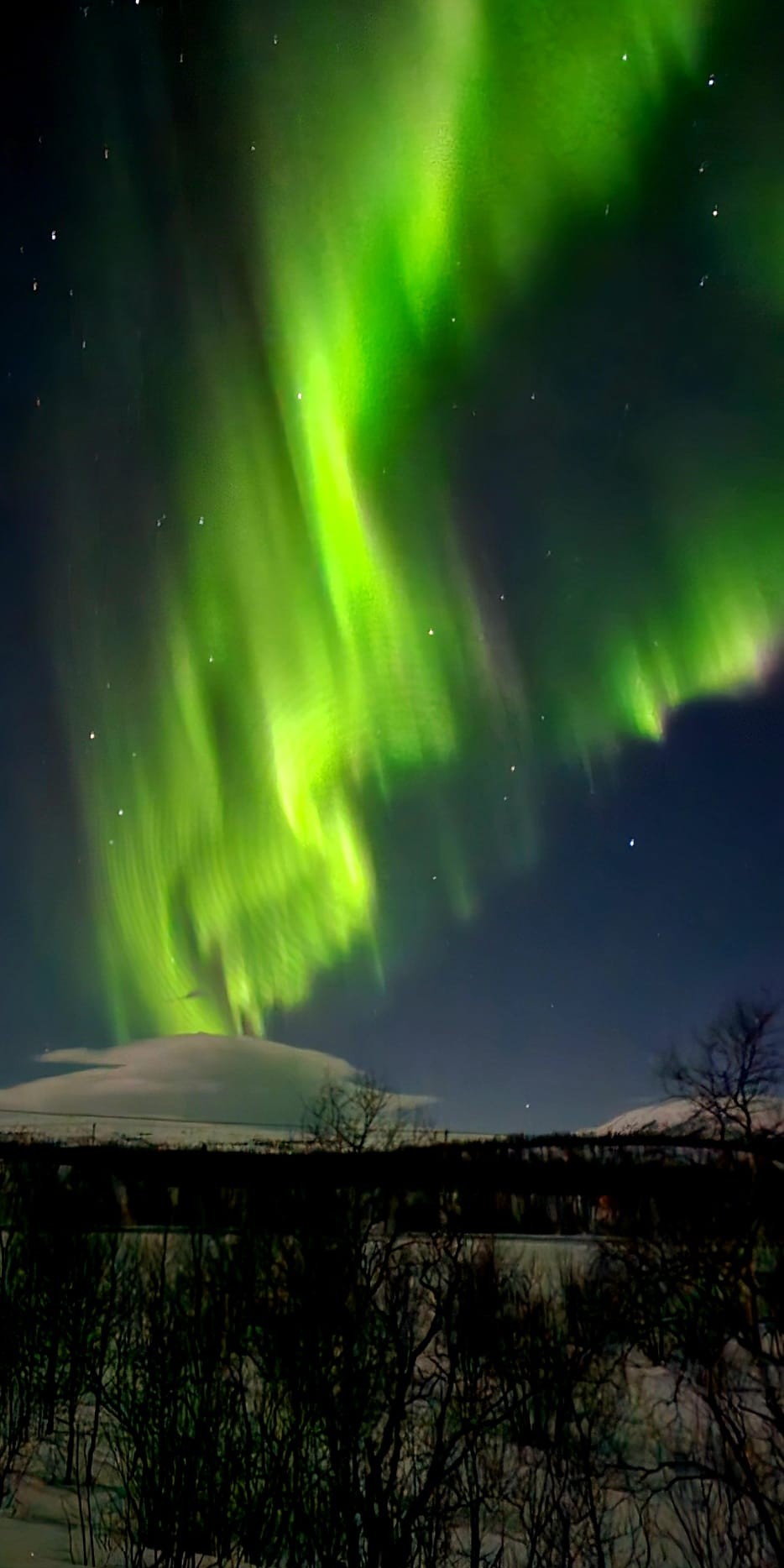
The short version: the best month to see the Northern Lights in Kiruna is February, with December, January and March close behind. The Northern Lights may be visible from late August into early April when the sky is dark enough, while the main season is generally September through March. Within that window the odds flip from weather (autumn) to solar activity (late winter). Below we break it down month by month with the data we use to plan our own tours.
Why Kiruna at all?
Kiruna sits at 67.8558° N, roughly 150 km north of the Arctic Circle. That latitude puts it almost directly under the auroral oval — the ring of permanent aurora activity around the geomagnetic pole. At 67° N aurora can be visible already at KP index 1–2 — the most common levels of geomagnetic activity — while far further south (Stockholm sits at 59° N) you generally need a strong geomagnetic storm. NOAA's aurora viewing guidance explains how visibility depends on KP and geomagnetic latitude.
The trade-off is weather. Kiruna is inland, which helps — coastal towns at similar latitude tend to get more maritime cloud. Cloudy spells alternate with clear windows through the winter; several partly clear nights in a typical mid-winter week is realistic, but there is no fixed number to count on — check SMHI's forecast close to your dates.
The aurora season window
The Northern Lights are always happening — the aurora oval is permanent. What changes is whether you can see them. Two things need to be true: the sky must be dark, and the sky must be clear.
Dark enough
"Dark" means astronomical twilight or deeper — the sun must be more than 18° below the horizon. In Kiruna this gives you the following window each season:
| Month | First true-dark hour | Last true-dark hour | Dark hours |
|---|---|---|---|
| September | ~22:30 | ~03:30 | 5 h |
| October | ~20:00 | ~05:00 | 9 h |
| November | ~16:30 | ~07:30 | 15 h |
| December | all day (polar night) | 24 h | |
| January | all day first half, then ~17:00–07:00 | 14–24 h | |
| February | ~17:30 | ~06:00 | ~12 h |
| March | ~19:30 | ~04:00 | ~8 h |
| Early April | ~21:00 | ~02:30 | ~5 h |
Polar night runs from approximately 12 December to 31 December. The sun doesn't rise at all. This sounds romantic but practically it means you can start aurora-hunting at 14:00 in the afternoon if the sky is clear.
Clear enough
Cloud cover below 30% is the practical threshold for aurora viewing. Below that you'll catch the display through any remaining gaps. Above 70% the aurora could be spectacular and you'd see nothing.
Approximate cloud probability in Kiruna by month, based on public SMHI historical weather statistics for the Kiruna area — planning guidance, not a forecast for your specific dates:
- September–October: 55–65% cloudy. Most volatile month.
- November: 60–70% cloudy. The year's worst month for cloud.
- December: 55% cloudy. Improving.
- January: 45–50% cloudy. Cold air dries out.
- February: 40% cloudy. Best month statistically.
- March: 45% cloudy. Still excellent.
Month by month
September — the soft opening (★★★)
The aurora season technically opens around 1 September when astronomical twilight returns. The dark window is still short (about 5 hours) and cloud cover is moderate. Temperatures are +5 °C down to −5 °C. Autumn colours are at peak which makes for some of the most visually interesting aurora photos of the year — birch trees in gold against green aurora. The catch: fewer hours means less margin if clouds roll in.
October — the underdog (★★★★)
Most guide books tell tourists to wait for December. They're wrong. October gives you 8–9 hours of darkness, relatively mild weather (you don't need thermal underwear yet), much cheaper flights and hotels, and genuinely dark skies from 20:00 onward. Equinox-adjacent solar activity tends to spike through October. If you can handle a 50% chance of cloudy nights, October offers the best value.
November — skip this one (★★)
November is the trap month. Everyone thinks the aurora season starts here, but cloud cover peaks around 65%, winds are high, and solar activity often dips right after the equinox spike. Unless you have a specific reason to visit in November, push your booking to December or wait until October.
December — polar night and the Christmas crowd (★★★★)
Polar night officially hits around 12 December. The sun doesn't rise. You can aurora-hunt in the afternoon. Cloud cover improves week over week as temperatures drop. This is the most-booked month — Christmas and New Year fill up early at many Kiruna accommodations and tours, so book well ahead. If you're flexible, come the first week of December before the crowds and the skies will be nearly as good as January.
January — the quiet peak (★★★★★)
January is where Kiruna hits its stride. Temperatures run −15 °C to −30 °C. Air is dry. Cloud cover drops. The tourist wave from Christmas has passed but the season is still in full swing. For photographers and anyone who wants small groups, January is our top recommendation.
February — the statistical best (★★★★★)
If you only get one shot, come in February. Solar activity has been building through the current cycle. Cloud cover is at its annual low. Astronomical nights are still 12 hours long. Temperatures are brutal (−25 °C is normal, −35 °C happens a few times per season) but that's what makes the air so clear. Every metric points to February as the single best month.
March — the last great month (★★★★)
Close to February in quality, with better weather. Days are rapidly lengthening but you still have 8 hours of darkness in mid-March. Geomagnetic activity is statistically somewhat elevated around the equinoxes (the well-documented Russell–McPherron effect), which can favour late March — though any individual week can still be quiet. By late March you can also start doing aurora-adjacent activities like day trips to Abisko National Park because daylight is back.
Early April — the last call (★★★)
The aurora season in Kiruna closes around the 10–15th of April. Nights shrink fast and by the 20th you're in permanent twilight. But early April can still deliver strong displays in active years. Come for the first week only.
The single week most first-timers get wrong
Every year we watch travellers book the exact wrong week: the first week of November. Tour prices look tempting because it's officially "aurora season", darkness has fully returned, and it's before the Christmas price spike. But cloud cover is typically at its seasonal worst and solar activity is often in a post-equinox lull. Even operators running frequent tours can hit a run of cloudy nights with nothing to show in early November. If your dates are flexible, shift by 3–4 weeks in either direction.
How many nights should you book?
Minimum three. Each extra night is another independent try against cloud and solar activity, so your cumulative chance of at least one sighting grows quickly with trip length — trip length is the single strongest lever you control. For a rough, assumption-based historical planning estimate for your own dates and trip length, use our aurora calculator: it shows the assumptions it uses and is a planning model, not a promised success rate.
Wherever you stay, plan to get away from direct town lighting on viewing nights — hoping to spot the aurora from a lit hotel window in central Kiruna meaningfully lowers your odds compared to dark skies.
What about the KP index?
The KP index is a 0–9 scale of planetary geomagnetic activity, published by NOAA SWPC. Low KP values are by far the most common — and at Kiruna's latitude aurora can already be visible at KP 1 under a dark, clear sky, with spectacular displays possible at KP 4+.
We built a live aurora conditions page for Kiruna that combines the current NOAA KP index with cloud cover from Open-Meteo into a simple conditions score (a planning score, not a calibrated probability). Bookmark it if you're planning a trip.
See tonight's aurora conditions for Kiruna → Live KP index + cloud cover + an honest conditions score.Booking a tour vs going alone
If you have a car, confidence driving on snow-packed roads at −30 °C, an insulated parka for standing outside for 2–3 hours, and patience to interpret the KP index and satellite cloud maps in real time, you can absolutely hunt the aurora on your own. Most travellers don't have all five of those. A guide solves the logistics and — critically — drives you to wherever the sky is actually clear, which can be a 60 km decision on any given night.
Our Kiruna Northern Lights tour runs with hotel pickup, warm drinks, light snacks, and basic phone photo help when possible. If no aurora appears we give a 50% discount on your next tour, subject to availability — see our policies.
Northern Lights Tour in Kiruna — from 1490 SEK → 3–4 hours, hotel pickup, guide speaks Swedish and Russian fluently plus practical English.One last thing
People ask us what the aurora "looks like in person" and the honest answer is: quieter than the photos. A phone camera accumulates light over 3-second exposures. Your eyes see the shape and the dancing but less of the green. Don't come expecting the Instagram version every night. Come for the combination of the cold, the silence, and the fact that a phenomenon 100 km above your head is visible because of solar wind disrupting Earth's magnetic field. Framed right, even a faint KP 2 display is unforgettable.
Whichever month you pick, book early, pack warmer than you think, and give yourself at least three nights. See you in Kiruna.